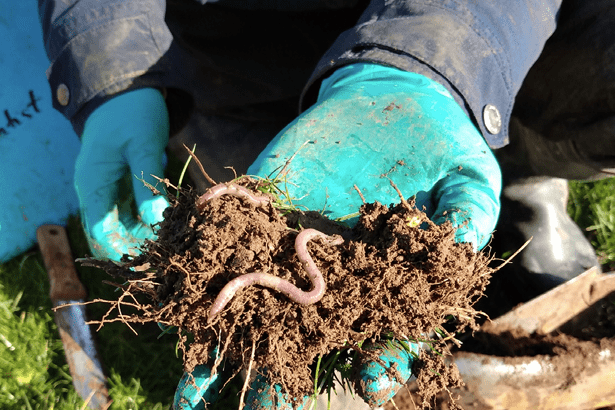
As part of the Talamh Beo Soil Biodiversity Literacy and Enhancement EIP project, a ‘simple, low-cost, holistic approach to testing for soil health’ was produced and made accessible to participants in the project. This was a key solution that allowed farmers to take ownership over the analysis, monitoring and management of their soils and trial plots. The toolkit includes the following elements:
- A digital booklet guiding farmers through soil testing methods
- Access to technical tools/innovations for testing
- Support and guidance in the use of technical and physical innovations
1. Digital soil testing booklet
The digital booklet uses information and visuals to guide farmers through conducting soil health checks, soil stability tests, infiltration tests, soil temperature checks, and above and below ground observations (See Figure A for an extract from the booklet). Through using the booklet to test their soils, farmers can then trial physical innovations to assist with different issues, e.g., moving from chemical to biological farming to address compacted soils depleted of Soil Organic Matter. Other physical innovations may include the use of soil biological activators, mineral amendments, biochar, green manure, compost, compost teas, inoculants, and different agroecological practices (such as regenerative farming, organic farming, permaculture, holistic land management). The digital booklet of the Soil Health Test Toolkit is available in the final report on Talamh Beo’s website.
The booklet was developed by the soil scientist within the EIP project. However, the Operational Group recommends that a future iteration should be developed in collaboration with farmers to better contextualise the information in the booklet. This co-creative approach would ensure that the primary focus is on the needs of farmers, and information is grounded in the context of why the soil testing is important, what certain results imply, and the benefits and costs of different solutions.
2. Access to scientific equipment
In addition to the soil testing booklet, the EIP project also provided each Lighthouse farmer with access to equipment for conducting soil tests. Each farmer received their own microscope and access to shared technical innovations. These included:
I. The Refractometer provides a measurement of soil moisture and food quality. By analysing the refractive index of a solution, it assesses the sugar content in crops. The insights into water holding capacity of soil, allows farmers to make decisions and plans for improving their soil conditions to ensure it is optimal for plant growth, quality and nutrition.
II. The bioNutrient meter measures the electrical conductivity of soil solutions, offering insights into the soil’s nutrient content, its ability to support plant health, and its carbon content. This allows farmers to conduct precise application of nutrients and organic amendments, to foster soil health. Moreover, it provides data for assessing and enhancing the nutritional quality of crops.
III. The compaction vane is a device used to measure the shear strength of soil, particularly for fine-grained, cohesive soils such as clays. This measurement helps determine how well the soil can resist shear stresses, which is important for understanding its stability and suitability for different farming practices.
3. Specialist advice and support
Ongoing support was made available to farmers alongside access to the equipment (e.g., via explainer videos on refractometer use, and interaction with the Operational Group). Moreover, participants also received assistance as they trialled different agroecological practices in response to their soil testing results (e.g., via online meetings and farm-walks). These additional modes of support and access to tools were revealed to be important based on farmers’ feedback at the end of the project. The combination of access to technical tools, the support for their use, and the soil testing booklet forms a useful toolkit for farmers to test their soil health in a relatively simple, low-cost way, ultimately facilitating better soil management at farm-level.
For more information about this innovation, contact Leo at leo@erinn.eu.