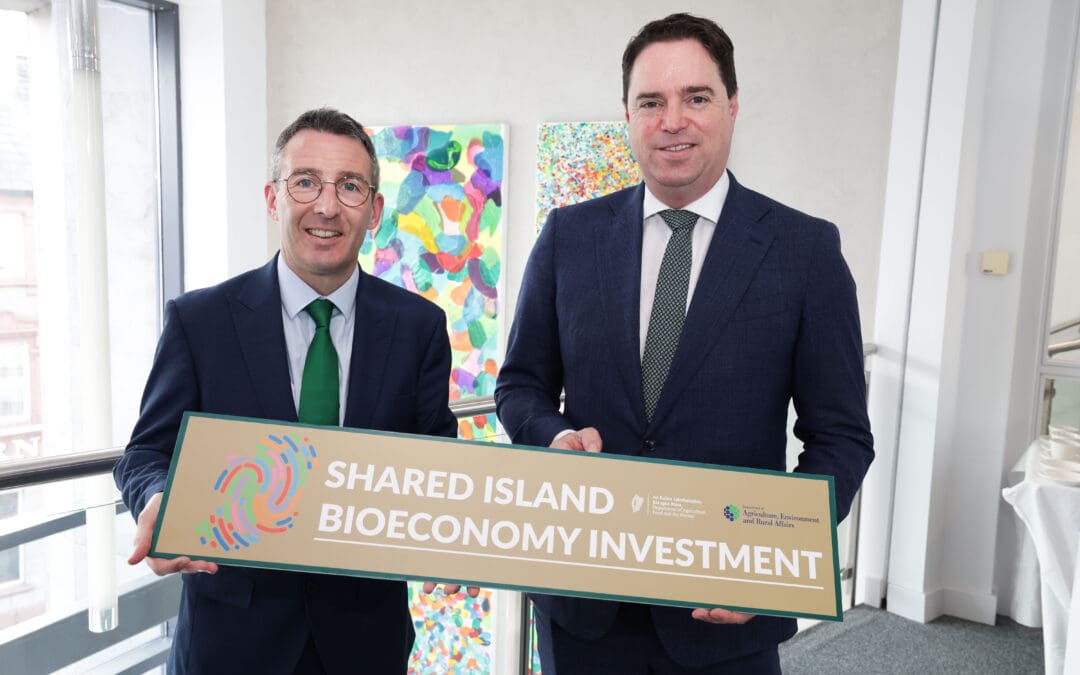
Taoiseach Micheál Martin TD, Minister for Agriculture, Food and the Marine, Martin Heydon TD, and Minister for Agriculture, Environment and Rural Affairs in Northern Ireland, Andrew Muir MLA, announced €9 million in funding for two bioeconomy demonstration initiatives. Marking the announcement, Taoiseach Micheál Martin said: “I am delighted to announce the award of funding for two new biorefinery demonstrator projects, as part of the Shared Island Initiative. Across the island, the challenges and opportunities we face across many sectors are comparable and connected, including on climate action and sustainability. This new programme deepens our cooperation with the Northern Ireland Executive on a shared goal. I look forward to seeing the contribution that each project will make in supporting expansion and development of the bioeconomy across the island of Ireland in the years ahead.”
Funding of €4.5 million is being awarded to the ‘Recycling Phosphates and Nitrogen from Agricultural Residues (REGENERATE)’ project led by Greenville Energy, based in County Tyrone. The project will bring together a range of partners from across the island of Ireland and will develop and produce a sustainable and bio-based fertiliser product. REGENERATE is committed to creating economically and environmentally sustainable products which can enhance industrial competitiveness while contributing to carbon reduction targets.
A further €4.5 million is being awarded to ‘All Island Marine Bio-based Refineries for Circular Blue-Bioeconomy (AIMBIO)’, which is led by Teagasc, Ashtown. Through collaboration and engagement with diverse stakeholders across the island of Ireland, the project will demonstrate the conversion of underutilized resources from aquaculture, fisheries, and aquatic processors, into high-value ingredients for applications in the food, feed, bio-based chemicals, and cosmetics industries.
Commenting on the two newly-funded initiatives, Minister Heydon stated: “The bioeconomy has the potential to offer new and exciting opportunities for our agriculture, food, forest and marine systems, as well as for strengthening our food security and reducing our reliance on critical dependencies. To unlock these opportunities, there is a need to scale up bioeconomy processes and technologies, to accelerate the commercialisation of bio-based products and solutions, and to create new value chains in which farmers, fishers and the agri-food industry can play a leading role.”
For more information on the bioeconomy visit our Bioeconomy in Ireland resource page.