The Farmer Moth Monitoring EIP Project builds on from the Protecting Farmland Pollinators EIP Project, also lead by the National Biodiversity Data Centre, that has identified small actions that farmers can take that allow biodiversity to coexist within a productive farming system.
The Farmer Moth Monitoring Project, which follows the EU Pollinator Monitoring Scheme recommendations published in 2020, tested the useability of a farmer led pollinator monitoring technique in the Irish context. Twenty farmers were recruited by the Project Co-ordinator from a larger group of farmers who were participating in the Protecting Farmland Pollinators EIP Project and provided with moth trapping training. The project tested the useability of a non-lethal moth (pollinator) monitoring technique across farmland of different types in the Irish context. Participating farmers were selected to cover a wide range of farm types (five dairy, five beef, five mixed and five tillage) and intensities.
Based on this pilot, the project has developed a robust and scientifically rigorous farmer led moth monitoring scheme that is suitable for a national roll out and that has the potential to assess how pollinator-friendly (moths) a farm is regardless of type, or intensity level.
While there are good records of the various moth species found in Ireland and their distributions, there is a gap in moth monitoring across the entire Island of Ireland, particularly on farmland. The data collected through this project also provides more information on whether the number of moth species vary according to farm type (beef, dairy, mixed and tillage) and land use within the farm.
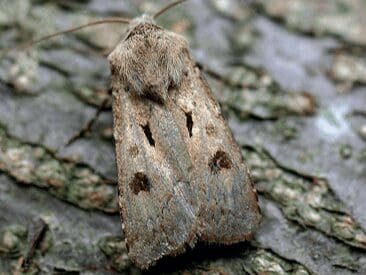
Over the course of the trapping period, 874 moths were identified. A total of 112 moth species were recorded, of which 28 were micro moths and the remaining 84 were macro moths. Traps situated along the hedgerow or field margin exhibited a greater variety and frequency of moth species. Using the data generated from this project, a flyer was produced on the six most common farmland moths with an image of each species and information on their distribution and key identification features. It also helps farmers and the public be more aware of the moths and pollinators on their land and become engaged in pollinator protections.
The practical nature of the trapping procedure and trap design have resulted in a highly cost-effective monitoring programme. The absence of any requirement for entomological experts to actively trap the moths onsite themselves gives this project a very broad scope and offers huge potential, as well as reducing the administrative burden. This scheme has helped farmers gain a better understanding of biodiversity and has allowed them to engage with nature on their land in a very positive way. It has also shown the general interest and willingness of farmers in Ireland to engage in and contribute to citizen science.
This project followed the EU recommendations suggesting that where possible, an additional module on moths is included in the EU Pollinator Monitoring Schemes. Having tested and confirmed the methodology for potential roll out of this additional moth module in Ireland, this monitoring programme has been funded further by DAFM to be rolled out on a phased basis over a 5-year period with an increasing number of participant farms joining the project each year.
You can find out more about the Farm Moth Monitoring EIP on the National Biodiversity Data Centre website at Farmer Moth Monitoring Project – National Biodiversity Data Centre.
For more information about this farmer-led moth monitoring scheme, please contact Claire Kearney at claire@erinn.eu.